Paris, Power, and Paper Money: The Echoes of Financial Past
From The Grand Experiment of Paper Money to A Financial Collapse. And To The Rise of the EU’s Largest Stock Exchange.
To Paris, France!
“C’est la vie.” That is life.

The awe-inspiring city of lights and love, Paris.
From the towering La Tour d’Eiffel, echoing the French fight for freedom, to the mighty Arc de Triomphe, symbolizing power, ambition, and glory. Paris carries stories that never fail to inspire.
And truly, what people say is right: you can never go wrong visiting this historically rich city.
But for me, one reason to visit Paris goes beyond its kings and queens, its churches, and its art. It’s about walking through its financial past, because Paris was home to one of the greatest financial disasters in history, the Mississippi Bubble of 1720.
I’ve read about it and even written about it on my website. But as a financial geek, just reading wasn’t enough. I wanted to see it, breathe it, walk the very paths Parisians did during those days of exuberance and collapse.
Why? Because history teaches us what has happened in the past, and what could happen again in the future. And most importantly, it shows us how financial bubbles form, how they burst, and how we might recognize the signs to help us manage a downturn.
This blog won’t be about rewriting the story of what has transpired in the Mississippi Bubble of 1720—you can read more about it through the blog link below. Instead, I’ll take you through the places I visited in Paris that connect to this financial mania.
And of course, as with every trip, I kept up my tradition: my “Stock Stop” series, visiting a stock exchange in every country I travel to. Because travel, for me, isn’t just about the sights, it’s about syncing my passion for the concept of money and finance with the places I explore.

Click on this link to access my Google Map Data of My Paris Financial Tour
So, without further delay. Let’s go!
The Roi Soleil, the Sun King Louis XIV
“When the rich wage war, it’s the poor who die.”
—Jean-Paul Sartre, French Philosopher of Existentialism

I wasn’t able to visit one of the grandest estates of the French Empire, the Palace of Versailles. But, I did get to see some of the crown jewels of French royalty at the Musée du Louvre.
The room itself mirrors the grandeur of Versailles: marble stone floors, walls adorned with intricate portraits and designs, and a ceiling painted by the finest artists of the time. It was, without question, a room built for royalty.
The star of the room is indeed the crown jewels, but when you look beyond it, you will find more than this, such as the portraits of France’s past kings and queens. Among them all, one stood out for me, the Roi Soleil, the Sun King, Louis XIV. (The photo above is one I took during my visit.)
Why did I focus on him alone when there were many other influential rulers? Because the story of the Mississippi Bubble begins with him.
During his reign, colonization and war were the main tools of power, a key to dominating trade, expanding influence, and asserting strength on the global stage. But war is costly. It drains manpower, resources, time, and above all, money. Financing wars, raising capital, and sustaining the empire’s ambitions became central to 18th-century France’s story, and ultimately, to the events that would lead to the bubble.
Louis XIV himself was more than just a king. He saw himself as divinely chosen by God
, ruling with a sense of absolute power. He elevated his reign to cosmic levels, even comparing himself to Apollo, the Greek Sun God. Henceforth, his title, “The Sun King.” France, in his eyes, revolved around him just as the planets revolved around the sun.


The Palais-Royal

Originally called the Palais-Cardinal, this grand estate was built in the 17th century for Cardinal Richelieu, one of France’s most powerful Catholic leaders. After his death, it passed into the hands of the monarchy and to King Louis XIV.
But in the context of the Mississippi Bubble, the most important figure tied to the Palais-Royal isn’t Louis XIV. It’s Philippe II, Duke of Orléans, the Sun King’s nephew.
When Louis XIV died, Philippe II became Regent of France, ruling on behalf of the young King Louis XV. The Palais-Royal became his residence, a place where state affairs were handled, and where aristocrats and other prominent French individuals gathered for social gatherings and entertainment.
Why is the King’s reagent an important person in the story? It is because Philippe II gave John Law—the Scottish economist—the influence and authority to implement his radical economic paper money experiment in France, which led directly to the Mississippi Bubble.
Today, the Palais-Royal houses the Ministry of Culture, the Conseil d’État, and the Constitutional Council. Its central gardens are open to the public and serve as a peaceful park in the heart of Paris.
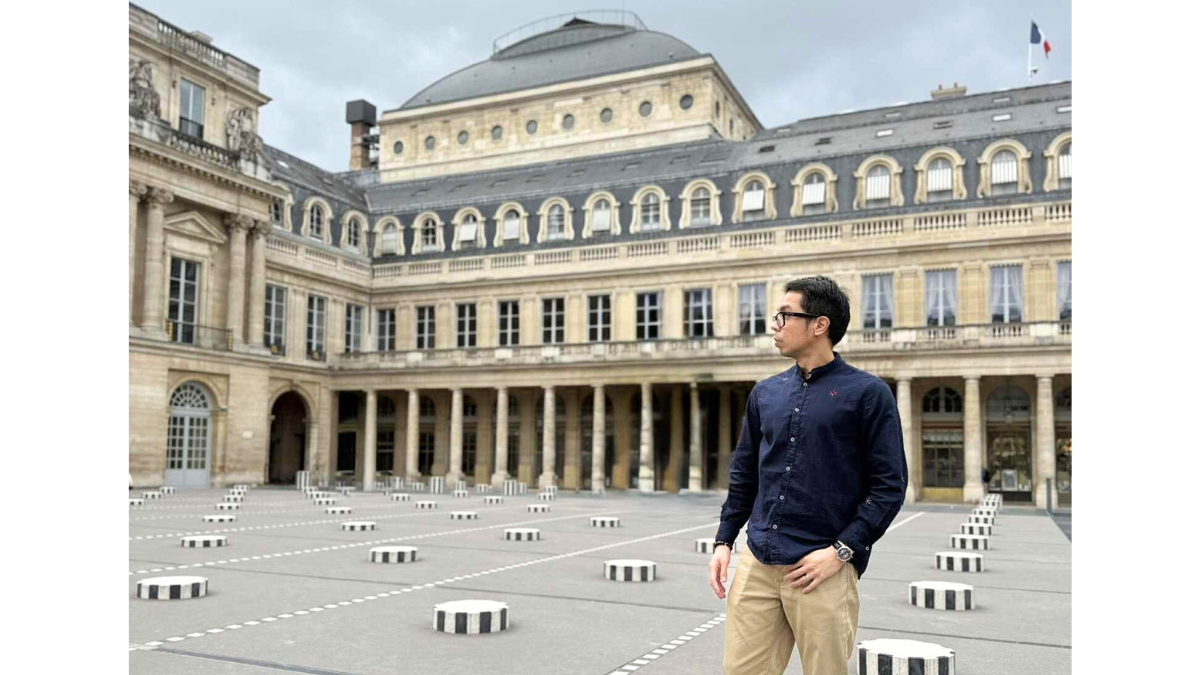
On my visit, my wife and I paused here for a short rest after exploring the largest museum in the world, the Musée du Louvre. We took a few photos, enjoyed the ambiance, which is quite a contrast to the busyness of the Louvre museum next door. It felt surreal knowing that this serene place once stood and contributed to one of the most dramatic financial manias in history.


Some of the photographs we’ve taken during our short stay in the Palais Royale.

Place Vendôme


The Parisian square landmark layered with history.
At its center stands the Vendôme Column, originally commissioned by Napoleon I. Inspired by Rome’s Trajan Column, it celebrates his victory at the battle of Austerlitz, considered by military historians as one of Napoleon’s greatest tactical masterpieces.
A statue of Napoleon crowns the top, a reminder of how deeply he drew from Roman culture. From his portraits in Roman emperor-like robes to monuments like the Arc de Triomphe, Napoleon consistently projected power through the legacy of Roman might.
But long before Napoleon left his mark here, Place Vendôme was tied to another figure, John Law. The Scottish economist once lived in one of the houses on this square. Law started France’s grand experiment with paper money, established its first central bank, and fueled the meteoric rise of the Mississippi Company. That boom eventually collapsed into one of the most infamous bubbles in history, shaking France’s economy and leaving scars that lingered for decades.
Today, the square tells yet another story, one of wealth and luxury. Place Vendôme is home to world-renowned brands like Rolex, Breguet, and the Ritz Hotel. Where once financial speculation and imperial ambition collided, now sits an enduring symbol of France’s elegance and prestige.

Rue Quincampoix / Quincampoix Street


Before, stock trading apps such as Robinhood (US), Trading212 (Europe), and eToro existed; there was Rue Quincampoix. An ordinary-looking street in Paris that, in the early 1700s, became the epicenter of stock speculation.
This cramped, 400-meter stretch doesn’t look like much when you walk it today. Most people would pass by without noticing anything special. But in the days of the Mississippi Bubble, it was the place where Parisians gathered to trade banknotes and shares of John Law’s Mississippi Company (Compagnie des Indes).
Imagine the scene: merchants, aristocrats, and ordinary citizens crowding the street, haggling over prices, all chasing the dream of striking it rich. In a way, Rue Quincampoix was the Robinhood app of its time. Instead of a digital marketplace, it was a physical marketplace for buying and selling shares, long before smartphones made trading just a swipe away.

When I visited Rue Quincampoix, I spotted a metal marker engraved with the history of the street. It was a confirmation of all the reading I had done on the bubble. Though I did need Google Translate to make sense of the French inscription (see photo above). Interestingly, these markers aren’t unique to this street. Paris installed many of them in the 1990s—shaped like ship paddles—as a way to preserve and share the city’s layered history.
Of course, the mania here ended in disaster. The collapse of the Mississippi Company and France’s first paper money experiment plunged the economy into turmoil. The fallout was severe enough that it took another 70 years before paper money would be permanently trusted in France, only gaining traction again during the French Revolution.
To dive deeper into the story of the Mississippi Bubble and its lessons, click the link below.

Stock Stops: Where Travel Meets the Stock Exchanges—Third Stop, Paris!!

I’m not particularly a travel-focused person; that’s more my wife’s primary interest. What I love is finance, the concept of money, history, and art. So, to find a middle ground that caters to both of our interests, I started my tradition of “stock stops”, where I visit and write about the financial landmarks and other interests of every country we travel to.
Paris, France, marks my third stop. And honestly, if someone were to travel their entire life, Paris would always find its way onto the bucket list. For a finance geek like me, though, the reason isn’t just the Eiffel Tower, Notre Dame, Arc Du Triomphe, or the Louvre; it’s the fact that Paris is home to the largest stock exchange in the European Union.
Euronext Paris

The history of the Paris Stock Exchange, or Bourse de Paris, stretches back to the early 18th century and is filled with transformations. From being a state-controlled institution to becoming a key player in today’s pan-European market.
Its official foundation came in 1724 by royal decree, created to bring order to the informal trading that had exploded in Paris, especially in the wake of the infamous Mississippi Bubble in 1720. At the time, the exchange didn’t have a permanent home but shifted around various locations in the city, one of which was Rue Quincampoix.
In the early 19th century, Napoléon Bonaparte decided to change that. Seeking to establish stability and prestige, he commissioned the Palais Brongniart, a magnificent neoclassical building that became the exchange’s permanent home for more than 150 years. For most of this era, trading was carried out through the traditional open outcry system, with brokers shouting bids and offers across the trading floor.
(Fun fact: I actually missed this landmark during my visit. I only found out about it afterward 😅.)

Modernization and Mergers

The late 20th century marked a period of radical change for the Paris Stock Exchange. By the 1980s, facing growing competition from international markets, the Bourse de Paris embraced electronic trading. This led to the launch of the CAC (Cotation Assistée en Continu) system, a fully computerized trading platform that gradually replaced the traditional open outcry system. This modernization also brought updated regulatory frameworks and expanded access to banks and financial institutions.
The most significant transformation came in 2000, when the Paris exchange merged with the stock exchanges of Amsterdam and Brussels to form Euronext, which is the first-ever pan-European equities market. Rebranded as Euronext group, the Paris exchange retained its iconic CAC 40 index, which remains a crucial benchmark for the French economy.
The CAC 40 is a capitalization-weighted index of 40 of the most significant companies listed on Euronext Paris, selected from the 100 largest by market capitalization.
Today, Euronext operates stock exchanges across seven European countries:
- France (Euronext Paris)
- The Netherlands (Euronext Amsterdam)
- Belgium (Euronext Brussels)
- Ireland (Euronext Dublin)
- Portugal (Euronext Lisbon)
- Italy (Borsa Italiana)
- Norway (Euronext Oslo)
As of today, Euronext has a combined market capitalization of $6.9 trillion. Impressively, Euronext Paris accounts for around 70% of this total, contributing about $4.9 trillion, followed by Euronext Amsterdam at $1.1 trillion.
Euronext Paris alone is home to over 800 listed companies, making it the dominant force within the Euronext group and the largest stock exchange in the European Union.

CAC 40 Index Constituents
Taken from the CAC 40 index fact sheet via the Euronext Group website. Data is as of 24 July 2025.
| Company | Ticker Symbol | Industry | Quick Note |
| SCHNEIDER ELECTRIC | SU | Producer Manufacturing | A global leader in energy management and automation, providing solutions for efficiency, sustainability, and digital transformation in industries and infrastructure. |
| LVMH | MC | Consumer Non-Durables | The world’s largest luxury goods conglomerate, owning iconic brands like Louis Vuitton, Moët & Chandon, and Hennessy, spanning fashion, jewelry, wines, and spirits. |
| TOTALENERGIES | TTE | Energy Minerals | A multinational energy company transitioning from traditional oil and gas to renewables, with operations in over 130 countries. |
| AIRBUS | AIR | Electronic Technology | A leading aerospace corporation that designs, manufactures, and delivers commercial aircraft, helicopters, defense, and space systems. |
| SAFRAN | SAF | Electronic Technology | Specializes in aerospace propulsion, aircraft equipment, and defense technologies, serving both commercial and military sectors. |
| AIR LIQUIDE | AI | Process Industries | A global leader in gases, technologies, and services for industry and healthcare, serving sectors like energy, chemicals, and electronics. |
| SANOFI | SAN | Health Technology | A top biopharmaceutical company focusing on vaccines, specialty care, and general medicines, with a strong global healthcare presence. |
| L’OREAL | OR | Consumer Non-Durables | The world’s largest cosmetics and beauty company, with a portfolio of brands across skincare, makeup, haircare, and fragrance. |
| BNP PARIBAS ACT.A | BNP | Finance | One of Europe’s largest banks, offering retail banking, corporate finance, and investment solutions. With operations in more than 65 countries, it plays a key role in global finance. |
| ESSILORLUXOTTICA | EL | Health Technology | A global leader in eyewear, formed from the merger of Essilor (lenses) and Luxottica (frames). It owns brands like Ray-Ban and Oakley, while also designing and manufacturing luxury eyewear for high-end fashion houses. |
To Sum It Up

France, like much of Europe, has shaped the world in ways we still feel today. From the creation of paper money and central banks to the ideals of the French Revolution, from building one of the largest stock exchanges in the world to pioneering mergers, its influence on finance is undeniable.
Finance, like technology, evolves. The value of a means of exchange is not static, it transforms to make life easier, more efficient, and more connected. But history shows that ground-breaking ideas are rarely accepted at first. They often meet doubt and skepticism until someone visionary persists. Slowly, a fraction of the population embraces the idea. Over time, more people are drawn to its promise, creating excitement, and sometimes, overexuberance.
This is the pattern we see again and again. People invest their time, energy, and money in a vision of the future that hasn’t fully arrived yet. In the rush, they forget that true change takes time. Unrealistic expectations lead to disappointment, and sometimes, devastating losses.
Paper money is a perfect example. The idea itself was revolutionary. But when John Law mismanaged it, the results were catastrophic. Yet the concept endured, eventually becoming a foundation of modern finance. Today, as we slowly transition to digital money, the echoes of that past are unmistakable. The same lessons apply to technology, from early tech booms to today’s AI revolution.
History doesn’t just teach us, it whispers. By listening closely, we can see the patterns, understand the risks, and anticipate the future. The past is not a story of what was, but a guide to what is happening right now.
Stock Stops: Third Stop Passport Stamped!

If you want to know more about the stock exchanges I’ve visited and plan to visit. See my Stock Stops page, where I shared details about my lifetime intention to visit each country with a stock exchange.
It is where my passion for finance and investing crosses with my increasing curiosity about the world.
“Life is about creating and living experiences that are worth sharing.”
— Steve Jobs
Knowledge is my Sword and Patience is my Shield,
Evan Louise Madriñan / elmads
This blog is for informational purposes only and not a Financial Recommendation. Not all information will be accurate. Consult an independent financial professional before making any major financial decisions.


0 Comments