From The Great Famine to Finance: The Rise of the Celtic Tiger
From the hardships of the Great Famine to the rise of the Silicon Docks and Euronext Dublin, explore how Ireland’s history helped shape its modern economy and financial markets.
To Dublin, Ireland!
An té a bhíonn siúlach, bíonn scéalach, He who travels has stories to tell
— Irish Proverb

Would you like to have a drink? Perhaps a pint of Guinness? Don’t fret, as there are pubs on almost every corner of bustling Dublin city.
Oh! Don’t think it is only a city of pub because it is also a city of literature that cultivated literary minds such as Samuel Beckett and Oscar Wilde.
Beyond that, to many locals, Dublin is known as the fair city, where the girls are so pretty. As the ballad goes:
“In Dublin’s fair city, where the girls are so pretty,
I first set my eyes on sweet Molly Malone.
As she wheeled her wheelbarrow, through streets broad and narrow,
Crying, ‘Cockles and mussels, alive, alive, oh!’”
Within the waters flowing into the River Liffey lie the tales of Dublin’s history, spanning millennia. From its beginnings as a settlement to its development into a bustling city, the river has witnessed the many changes that have shaped Dublin over the centuries.
Like with other countries I have visited, I too explored Dublin’s financial and economic history to see how the past shaped the country it is today.
From Celtic migration to Christianity. From Viking raids to British colonial rule, from the Great Famine to the country’s transformation into one of the most remarkable economic miracle in modern history.
Come join me as I write about Dublin City and its economic and financial history that helped shaped Ireland.
NOTE: This blog is the eighth entry in my Stock Stop Series, where I explore the financial and economic history of the countries I visit.
Why do I do this? It’s because a nation’s growth is inseparable from its capital and resources. And as economies grow, financial markets can play an important role in that development. Where there’s a stock exchange, there’s also an opportunity for everyday individuals, like you and me, to participate in the financial markets, build wealth and work towards achieving our long-term financial goals
The Land of the Goddess Ériu

The earliest inhabitants of Ireland remain unknown, but in recorded history, it is believed that the Celts migrated to Ireland from across Europe.
They called the island Ériu, a name associated with the goddess of sovereignty and fertility in Irish mythology.
The Celts, like other peoples in Europe, such as the Slavs, Germanic peoples and Huns, were part of the many groups that shaped the continent’s history before and during the height of the Roman Empire. Celtic tribes are believed to have made up much of Ireland’s population during this period.
They lived across Ireland for centuries, developing their Celtic pagan beliefs and speaking languages that eventually evolved into Irish Gaelic. The Celts didn’t have large, unified kingdoms; instead, they lived in separate tribes, each with its own territory, leaders and smaller kingdoms.
The stories and history of Ireland were passed down through generations through oral traditions, ballads and songs. Then came Christianity, which brought literacy and learning to the country.
As the Roman Empire fell around the 5th century AD, Christians who lived in Britain continued their missionary work in Ireland. Figures such as St. Patrick, in particular, had a substantial influence on Ireland and its inhabitants during this period. Over the following centuries of Christian missionary work, Catholicism became firmly established throughout Ireland, largely through gradual conversion rather than widespread forced conversion.
From then onwards, monasteries sprang up across the land, bringing literacy and learning. Monks began recording Ireland’s history through its oral traditions, alongside producing religious scriptures and other written works.

One of the most notable manuscripts produced by monks is the Book of Kells. Although it is believed to have originated in a monastery associated with Iona, Scotland, the monks eventually continued their work in Ireland, particularly as they relocated due to the vicious Viking raids.
Around 795 AD, Vikings from Scandinavia began attacking the coastal settlements and monasteries of Ireland. Britain wasn’t spared from Viking raids either.
Throughout the centuries of these raids, the Vikings established permanent settlements and trading posts along Ireland’s coast. This gave rise to cities we know today, such as Dublin, Cork and Limerick.
The Irish and Norsemen engaged in several skirmishes to gain dominance, until the Irish eventually regained the upper hand in many parts of the island. Despite this, Ireland’s political power remained fragmented, creating an opening for another power that would eventually dominate and colonise much of Ireland for centuries.
The Normans, who originated in Normandy and were ancestors of some of the people who would later become part of the English ruling class, arrived and conquered parts of Ireland in the late 12th century. However, Ireland wasn’t brought under the full authority of the English Crown until much later, particularly during the Tudor and early Stuart periods. This marked the gradual collapse of the old Gaelic order.
The Great Famine of Ireland

“The Almighty, indeed, sent the potato blight, but the English created the famine.”
—John Mitchel, 1861
The potato was the staple food of the Irish people in the mid-19th century. It was a crop that thrived in Ireland’s climate, making it relatively easy to plant and cultivate.
One of the reasons the potato was so important was that beef and other agricultural products were exported to Britain, leaving many Irish people with limited access to other food sources. Potatoes, on the other hand, were easier to cultivate and provided substantial nutritional value relative to the land required to grow them.
Much of Ireland’s land was controlled by English and Anglo-Irish landlords, leaving many Irish farmers working as tenants on agricultural land.
The potato had sustained the nutritional needs of the Irish population for generations. However, this dependence would become one of the darkest chapters in Irish history. Fate dealt the Irish people another devastating blow in 1845.
Farmers discovered that their potato crops had turned black and rotten. A fungus-like organism infected the potato crops across Ireland, spreading rapidly throughout the land. This outbreak became known as the Potato Blight. Although the blight itself did not directly cause illness in humans, the resulting destruction of the potato harvest led to widespread starvation, malnutrition and disease, including diarrhoea, abdominal pain and vomiting. In the worst cases, these conditions contributed to death.
Potatoes originally came to Europe from South America, eventually reaching Ireland through Spanish trade routes and continental Europe. (I’ve written about the Spanish trade routes in my seventh Stock Stop Series entry, following my visit to Seville, Spain, in the summer of 2026.)
The potato blight was caused by Phytophthora infestans, a pathogen believed to have originated in the Americas. It also devastated potato crops in other European countries at the time, including Belgium and the Netherlands.
However, unlike Ireland, where much of the impoverished population depended heavily on potatoes, other European countries generally had more diverse food supplies to help them withstand the crisis.
The Irish were mostly impoverished and highly dependent on potato crops at that time. As the harvests failed, the blight caused a massive food shortage that disproportionately affected the poor. This food crisis became a national catastrophe, made even worse by the British government’s response.
During the seven-year period associated with the Great Irish Famine, Ireland remained under British rule as part of the United Kingdom of Great Britain and Ireland. The Parliament in London introduced various measures to alleviate the crisis, including two notable actions:
1.) Imported corn from the Americas.
2.) Employed Irish people in public works projects.
However, these measures failed to stop the growing starvation and worsening health conditions among the Irish population. The imported corn was unfamiliar to many Irish people and did not provide an adequate solution to the widespread food crisis on its own. Furthermore, the population’s nutritional needs became increasingly important as starvation and disease weakened people’s bodies.
On top of this, the public works projects were physically demanding, labour-intensive and often required long working hours. Once again, the available food supplies were insufficient to meet the nutritional needs of people already weakened by hunger and disease.
While all of this was happening, the British Parliament continued to import beef from Ireland. They believed that the reports of famine in Ireland were exaggerated, and they refused to provide additional aid. Even if they provided relief, the government limited who could receive it.
The British government could clearly have implemented better policies to help the Irish people during this period. The government did not lack all the resources or means to provide relief, but its response was constrained by political decisions, economic ideology and a lack of sufficient action to address the scale of the catastrophe.
Depending on whom you speak to today, the Great Famine of Ireland, also known as the Irish Potato Famine, is viewed by some as the Great Irish Genocide of the 19th century, with the British government’s policies and actions regarded as central to the tragedy. However, the classification of the famine as genocide remains a subject of historical debate.
The estimated number of deaths associated with the Great Irish Famine was approximately one million.
According to Ireland’s 1841 census, the island’s population stood at approximately 8.1 million. By the 1851 census, it had fallen to around 6.5 million. This decline resulted from a combination of deaths and mass emigration during and after the famine.
In 2026, the island of Ireland has approximately 7.1 million people across both the Republic of Ireland and Northern Ireland. Clearly, the island has yet to return to the population levels recorded before the Great Famine.
The photographs above show the famine memorial statues erected in Dublin in remembrance of the Irish people who suffered and died during the Great Irish Famine.


The Celtic Tiger: Republic of Ireland’s Economic Miracle

“Dá fhad an lá tagann an tráthnóna, No matter how long the day, the evening will come”.
—Irish Proverb
Ireland’s economy under British rule had been impoverished compared to those of its European peers. It was predominantly an agrarian economy that relied heavily on livestock and crop exports. This relatively poor economic standing continued even after Ireland gained independence from British rule in 1921 and eventually became the Republic of Ireland in 1949.
Ireland didn’t participate in World War II as a combatant, instead maintaining a policy of neutrality while attempting to rejuvenate its economy and undergo industrialisation. However, these efforts didn’t deliver the economic growth the country had hoped for. Mass emigration continued, its population remained relatively small at around 3 million, and the loss of people presented further challenges to economic growth. Many continued to struggle to meet their basic needs.
These unfortunate economic circumstances would soon give way to what would become one of the most remarkable economic transformations in modern history.
Ireland became the second-highest-ranking country in Europe in terms of GDP per capita, after Luxembourg. Its GDP grew at a staggering rate of around 8% per year between 1995 and 2025, rising from approximately US$69 billion to US$721 billion. The UK, on the other hand, recorded an average annual growth rate of around 3.6% over the same period.
Ireland achieved such a remarkable transformation through several economic policies. One of the most well-known was its decision to lower the corporate tax rate to 12.5% in the 1990s. This rate remained in place for many years. In comparison, the UK’s main corporation tax rate was around 30–35% during much of the 1990s, before standing at 25% in 2026.
On top of that, Ireland had been a member of the European Economic Community, now the European Union, since 1973. This meant that establishing a business in Ireland also offered access to the wider European single market.
And this turned a few heads among some of the world’s largest companies, most notably technology giants such as Google, Meta and Amazon. Lower corporate taxes, access to the European market and other incentives? Anyone?
But before the Irish government could fully capitalise on these opportunities and attract international companies to establish subsidiaries in the country, they needed suitable locations to accommodate them. So, they looked towards their docklands. What better way to do this than to revitalise and redevelop these historic waterfront areas?
NOTE: The Celtic Tiger refers to a period of rapid economic growth and modernization in the Republic of Ireland from the mid-1990s until the global financial crash in 2008. Their GDP growth during that time was around 10% per year. Mind blowing!
The Rise of Dublin’s Silicon Docks

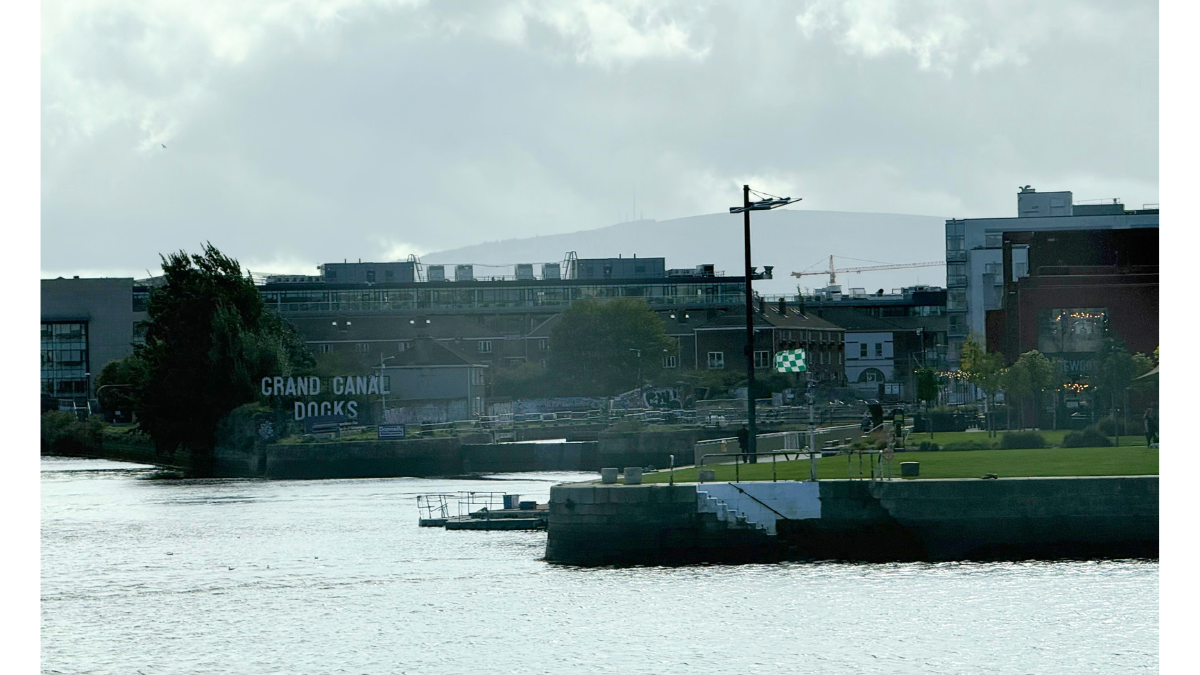
The Grand Canal Dock in Dublin, which connects to the River Liffey, first opened in 1796. During its heyday, it was one of the largest dock systems in the world. It flourished as a hub of maritime trade, particularly in grain and coal. Then, in the early 19th century, a new technology emerged that would contribute to the decline of Dublin’s Grand Canal Dock. The rapid expansion of the railways diverted a substantial amount of freight traffic that maritime trade had traditionally carried.
It was a long and gradual decline for Dublin’s Grand Canal Dock. By the 1960s, the dock had been abandoned and neglected. It eventually became a toxic wasteland due to contamination from a gas manufacturing company operating in Dublin.
In the 1990s, the Irish government and the Dublin Docklands Development Authority (DDDA) invested roughly $50 million in decontaminating the area. Following the successful decontamination project, infrastructure was developed to accommodate international corporations interested in taking advantage of Ireland’s low corporate tax rates and access to the European Union’s Single Market.
In 2004, Google opened its regional subsidiary in Ireland, paving the way for other international companies to follow suit, including Amazon, Meta and Mastercard.
With technology companies popping up like mushrooms across Dublin’s docklands, so did Ireland’s GDP. This contributed to what became known as the Irish economic miracle, bringing greater prosperity to the country. The Grand Canal Dock area also became known by another name: the Silicon Docks, inspired by the technology giants that established their offices here.
While this economic prosperity is magnificent, some economists argue that the Republic of Ireland’s GDP growth is inflated by accounting practices that do not necessarily reflect the economic reality experienced by ordinary Irish people. They argue that Ireland’s underlying economic growth is lower than the headline figures suggest, a concern also reflected in the cost of living faced by its people. Economist Paul Krugman even called it the Leprechaun economy.
Some economists believe that Gross National Income (GNI) provides a more accurate picture of Ireland’s economic health, while others advocate for alternative measures beyond both GDP and GNI. This is a topic of its own, but much of the debate comes down to Ireland’s corporate tax policies.
You see, lower taxes mean that the Republic of Ireland collects less tax revenue from international corporations, while these corporations can repatriate a greater share of their profits to their home countries. As a result, less of that wealth may circulate within the Irish economy. Yet this does not necessarily become apparent when looking at GDP figures alone.
Nonetheless, it is undeniable that the Republic of Ireland has progressed economically and become more prosperous than at almost any other point in its recorded history, since the days when the Celts first called this land Ériu.
Ha’ppeny Bridge

“I leaned my arms on the Ha’penny Bridge where people used to pay half a penny to cross the Liffey…”
—Tana French
You can’t go to Dublin and not see the famous Ha’penny Bridge. It is Dublin’s first pedestrian bridge, built in 1816 across the River Liffey.
The problem for Dubliners was that the River Liffey cuts across Dublin, effectively bisecting the city. If you lived on one side of the river and your workplace was on the other, how would you get there?
The obvious answer today is to build a bridge connecting the two sides. Even a child could think of that!
That said, you might wonder why the Ha’penny Bridge was only built in 1816 when Dublin was founded in 841 AD. That’s indeed a good question.
Prior to the construction of the Ha’penny Bridge, ferries had served as the main means of crossing the River Liffey for centuries. You could say that the ferries provided a water-taxi service during those times.
William Walsh operated seven ferries in the early 19th century. However, his ferry fleet deteriorated due to wear and tear. The city authorities informed him that he either had to repair his entire fleet or build a permanent bridge. He chose the latter.
The Ha’penny Bridge famously got its name because William Walsh charged travellers and commuters a toll of “half a penny” to cross it for over 100 years.
William Walsh’s decision to build the Ha’penny Bridge was a good financial and business move. It gave him a cash cow. Every time someone crossed his bridge, he earned a steady stream of income, and he and most likely his children and grandchildren continued to do so for over 100 years. Other bridges were built soon after, but the Ha’penny Bridge continued to serve an important part of Dublin, bringing Walsh a steady income along the way.
That’s what I call a golden bridge. Hahaha!😆
The Irish Stock Exchange (Euronext Dublin)

My Dublin trip and Stock Stop travel series wouldn’t be complete without visiting the country’s premier stock exchange, Euronext Dublin.
The stock exchange traces its roots back to 1793, when it was established by local brokers. Then in 1799, it received a formal recognition. It was originally known as the Irish Stock Exchange, a name it retained for much of its history.
Like many of the world’s oldest stock exchanges, the Irish Stock Exchange began as a market where businessmen traded goods, commodities and bills of exchange. And like other centuries-old institutions, it moved between different locations across Dublin over the years. From the Royal Exchange, now known as Dublin City Hall, to a commercial hall on Dame Street, and finally to its current location in the Exchange building beside the Bank of Ireland.
Then, in 1973, the Irish Stock Exchange lost its independence when it merged with the British stock exchange, becoming part of the International Stock Exchange of Great Britain and Ireland, which is now known as the London Stock Exchange.
As Ireland regained its freedom and independence from British rule, so too did its stock exchange. Under the Stock Exchange Act 1995, the exchange regained its independence.
More recently, in March 2018, the Euronext Group acquired the Irish Stock Exchange and renamed it Euronext Dublin, integrating Ireland into its pan-European exchange network. I’ve written about the history of the Euronext Group in my Paris Stock Stop blog, titled Paris, Power, and Paper Money: The Echoes of Financial Past.
Today, Euronext Dublin operates as part of the wider Euronext Group. It continues to support domestic equities trading while also serving as a major international hub for debt securities, bonds and investment fund listings.
Currently, the exchange has more than 20 companies listed. This represents a substantial decline from the approximately 65 companies listed two decades ago. Like the London Stock Exchange, the decline in the number of listed companies could be attributed, in part, to public companies moving to US stock exchanges and private equity buyouts.
NOTE: The Euronext Group owns and operates eight different stock exchanges across eight countries. So far, I’ve visited only two of them: Paris and Dublin. I hope to visit the remaining six in the future, and you can be sure that I’ll write another Stock Stop Series about them. Stay updated!
Ireland Overall Stock Exchange Index (ISEQ 20)
The Ireland Overall Stock Exchange Index, shortened to ISEQ 20, is Euronext Dublin’s main benchmark index. It tracks the 20 largest companies and most liquid companies listed on Euronext Dublin.
It serves as the primary national benchmark and indicator for the Irish stock market, similar to:
- the S&P 500 in the US
- FTSE 100 in the UK,
- CAC 40 in France, and
- PSEi in the Philippines
Below are the ISEQ 20 constituents taken from the ISEQ 20 index fact sheet via the Euronext Group website. The data is as of 13 October 2026.🔗https://live.euronext.com/en/product/indices/IE00B0500264-XDUB
| Company | Ticker Symbol | Industry | Quick Note |
| RYANAIR HOLDINGS PLC | RYA | Transportation | One of Europe’s largest low-cost airline groups, operating flights across Europe and other markets. Its business model focuses on low fares, cost efficiency and high aircraft utilisation. |
| AIB GROUP PLC | A5G | Finance | One of Ireland’s major banking groups, providing personal, business and corporate banking, alongside lending, savings, mortgages and other financial services. |
| BANK OF IRELAND GROUP PLC | BIRG | Finance | One of Ireland’s oldest and largest financial institutions, offering retail banking, business lending, mortgages, savings and corporate financial services. |
| KERRY GROUP PLC | KRZ | Process Industries | A global taste and nutrition company supplying ingredients, flavouring systems and food solutions to manufacturers across the food, beverage and pharmaceutical industries. |
| KINGSPAN GROUP PLC | KRX | Non-Energy Minerals | A global provider of high-performance insulation and building envelope solutions, helping improve energy efficiency and sustainability in residential, commercial and industrial buildings. |
| GLANBIA PLC | GL9 | Consumer Non-Durables | An international nutrition company specialising in dairy ingredients, nutritional solutions and sports nutrition products, serving both food manufacturers and consumers. |
| HAMMERSON PLC | HMSO | Finance | A real estate investment company focused on owning, managing and developing retail destinations and urban real estate across selected European markets. |
| CAIRN HOMES PLC | C5H | Consumer Durables | An Irish homebuilding company focused on developing residential properties, particularly new homes and apartment communities, to address housing demand in Ireland. |
| GLENVEAGH PROPERTIES PLC | GVR | Consumer Durables | An Irish homebuilder developing residential properties and communities, with a focus on delivering new housing across Ireland. |
| UNIPHAR PLC | UPR | Distribution Services | An international healthcare services and pharmaceutical distribution company supplying medicines and healthcare products to pharmacies, hospitals and other healthcare providers. |
To Sum It Up

Ireland and its people have endured centuries of hardship and suffering. Despite this, their culture has remained strong and has never faded away. This is reflected in the streets of Dublin, its pubs, the art displayed on its streets and in its national gallery, its literature and architecture. And, more importantly, its Guinness. 🍺
Its population may not yet have returned to its previous peak in the mid-1800s, but its economy has grown substantially beyond what it once was. The goddess Ériu would have been proud to see how far Ireland has come.
Stock Stops: Seventh Stop Passport Stamped!

If you want to know more about the stock exchanges I’ve visited and plan to visit. See my Stock Stops page, where I shared details about my lifetime intention to visit each country with a stock exchange.
It is where my passion for finance and investing crosses with my increasing curiosity about the world.
“Life is about creating and living experiences that are worth sharing.”
— Steve Jobs
Knowledge is my Sword and Patience is my Shield,
Evan Louise Madriñan / elmads
This blog is for informational purposes only and not a Financial Recommendation. Not all information will be accurate. Consult an independent financial professional before making any major financial decisions.
- A bronze statue of a fishmonger named Molly Malone, who is a star of a well-known Irish song. ↩︎
- The Brian Boru Harp (also known as the Trinity College Harp or cláirseach) is a 14th- or 15th-century medieval Irish wire-strung harp housed in the Long Room at Trinity College Dublin. It serves as the official national emblem of Ireland and is renowned as one of the oldest surviving instruments of its kind. As an instrument of the traditional gaelic harping tradition, it represents the primary medium through which Irish history, genealogy, and mythology were orally preserved and passed down through generations via ballads and songs. ↩︎
- The Book of Kells is a 1,200-year-old (circa 800 AD) illuminated manuscript containing the four New Testament Gospels in Latin, and it is widely celebrated as Ireland’s greatest cultural treasure and a pinnacle of Insular art. (More about this in this link https://www.visittrinity.ie/blog/why-is-the-book-of-kells-important/) ↩︎
- The famine memorial is in remembrance for the people who died during the Great Famine of Ireland. It can be found on Customs House Quay, Dublin. ↩︎
- Temple Bar, Dublin is famous as the city’s premier cultural, nightlife, and entertainment district. You will be greeted with the narrow medieval streets and the iconic bright-red and most famous Pub in Dublin, the Temple Bar Pub ↩︎


0 Comments